Fuzzy order-sorted feature (OSF) logic
Fuzzy sort taxonomies
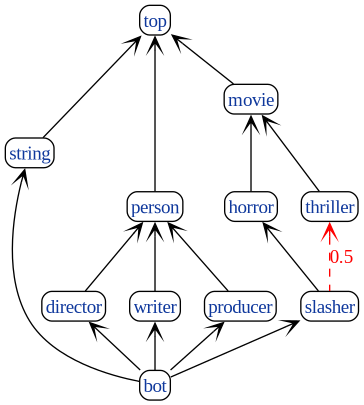
Sorts denote fuzzy sets. A fuzzy sort taxonomy is a fuzzy lattice (or a fuzzy partial order).
from fosf.parsers import parse_taxonomy
from fosf.syntax import Sort
from fosf.utils.draw import notebook_display as display
fuzzy_taxonomy_str = """
bot < director, writer, producer, string, slasher.
director, writer, producer < person.
slasher < horror, thriller (0.5).
thriller, horror < movie.
person, string, movie < top.
"""
fuzzy_tax = parse_taxonomy(fuzzy_taxonomy_str)
bot (⊥) denotes the empty set, and top (⊤) denotes the whole domain/universe.
type(fuzzy_tax)
fosf.syntax.taxonomy.FuzzySortTaxonomy
display(fuzzy_tax)
Greatest lower bound (GLB, or meet) computation, representing set intersection.
movie = Sort("movie")
thriller = Sort("thriller")
horror = Sort("horror")
slasher = Sort("slasher")

person = Sort("person")
producer = Sort("producer")
writer = Sort("writer")
string = Sort("string")
fuzzy_tax.glb(thriller, horror)
Sort('slasher')
fuzzy_tax.glb(person, producer)
Sort('producer')
fuzzy_tax.glb(string, movie) # the intersection of 'string' and 'movie' is empty
Sort('bot')
Checking (fuzzy) subsumption:
fuzzy_tax.is_subsort(slasher, movie)
True
fuzzy_tax.is_subsort(writer, movie)
False
fuzzy_tax.degree(slasher, movie)
1.0
fuzzy_tax.degree(slasher, thriller)
0.5
OSF constraints and clauses
OSF constraints are simple expressions like:
X:movie, meaning that the entity denoted byXis of sort (type)movie.X.directed_by = Y, meaning that the entity denoted byXis directed by the entity denoted byY.X = Y, meaning that the entities denoted byXandYare the same.
Where X is a tag (variable), movie is a sort, and directed_by is a feature (functional attribute).
A conjunction of constraints forms an OSF clause.
from fosf.parsers import parse_clause
clause_str = "X:movie & X.directed_by = Y & Y:director & X.written_by = Z & Y = Z"
clause = parse_clause(clause_str)
print(f"The clause {clause} is composed of the following constraints:")
for constraint in clause:
    print(f"\t- {str(constraint):17s}` of type {type(constraint)}")
The clause X : movie  &  X.directed_by = Y  &  X.written_by = Z  &  Y : director  &  Y = Z. is composed of the following constraints:
	- X.written_by = Z ` of type <class 'fosf.syntax.constraints.FeatureConstraint'>
	- Y : director     ` of type <class 'fosf.syntax.constraints.SortConstraint'>
	- X : movie        ` of type <class 'fosf.syntax.constraints.SortConstraint'>
	- X.directed_by = Y` of type <class 'fosf.syntax.constraints.FeatureConstraint'>
	- Y = Z            ` of type <class 'fosf.syntax.constraints.EqualityConstraint'>
Graphical representation of an OSF clause:
display(clause)
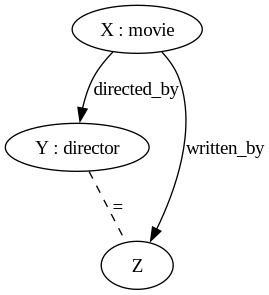
The clause represents some movie X directed by some Y (who is a director) and written by some Z (implicitly of sort top), and Z and Y are the same entity.
OSF constraint normalization
from fosf.reasoning import normalize_clause
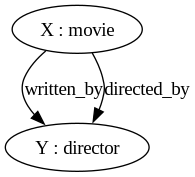
OSF clauses can be simplified into a normal form.
normalized_clause = normalize_clause(clause, fuzzy_tax)
display(normalized_clause)
A slightly more complex example:
clause_str = """
X:movie       & X.title = W        & W: string &
X1 : thriller & X1.directed_by = Y & Y : director &
X2: horror    & X2.written_by  = Z & Z : person & X2.directed_by = Z
    & X = X1 & X = X2
"""
clause = parse_clause(clause_str)
Before normalization:
display(clause)
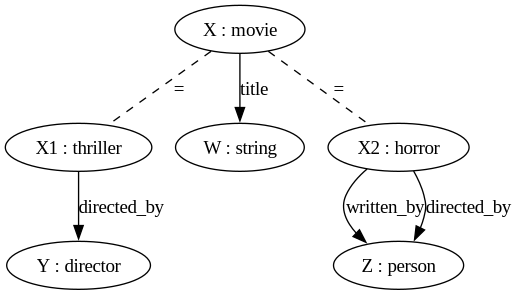
After normalization:
display(normalize_clause(clause, fuzzy_tax))
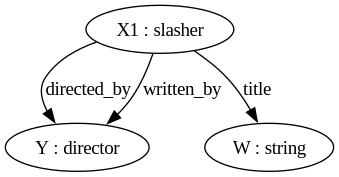
The normalization works as follows:
Since
X,X1andX2are supposed to be the same entity, then this entity must be amovie, athrillerand ahorrorat the same time. According to OSF logic, the sort associated with this entity must be the GLB of these three sorts, i.e.,slasherSince features are functional and we have
X1.directed_by = Y,X2.directed_by = ZandX1 = X2, then we must haveY = Z.Etc.
OSF Terms
An OSF term is another type of syntactic expression in OSF logic, which generalizes first-order terms.
Every OSF term can be rewritten as an OSF clause, and (rooted solved) OSF clauses can be rewritten as (normal) OSF terms.
from fosf.parsers import parse_term
term_str = """
movie(
    directed_by -> Y:director,
    written_by -> Y,
    title -> string
)
"""
term = parse_term(term_str)
print(term)
X0 : movie(directed_by -> Y : director, written_by -> Y, title -> X1 : string)
term.pretty_print()
X0 : movie(
    directed_by -> Y : director
    written_by -> Y
    title -> X1 : string
)
display(term)
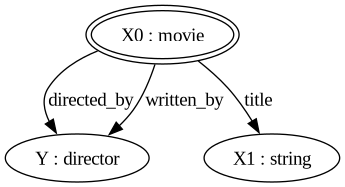
Translating into an OSF clause:
print(term.to_clause())
X0 : movie & X0.directed_by = Y & X0.title = X1 & X0.written_by = Y & X1 : string & Y : director.
OSF term normalization
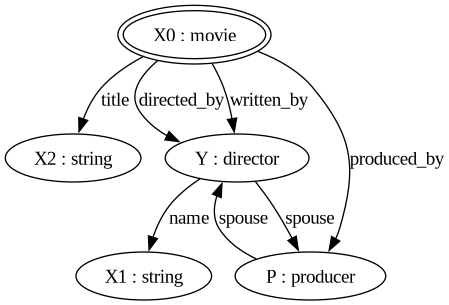
OSF terms with reduntant sorts/features can be normalized
from fosf.reasoning import normalize_term
term_str = """
movie(
    directed_by -> Y:director(spouse -> P:producer),
    directed_by -> Z:person(name -> string),
    written_by -> Y,
    produced_by -> P(spouse -> Y),
    title -> string
)
"""
term = parse_term(term_str)
print(term)
X0 : movie(directed_by -> Y : director(spouse -> P : producer), directed_by -> Z : person(name -> X1 : string), written_by -> Y, produced_by -> P(spouse -> Y), title -> X2 : string)
display(term)
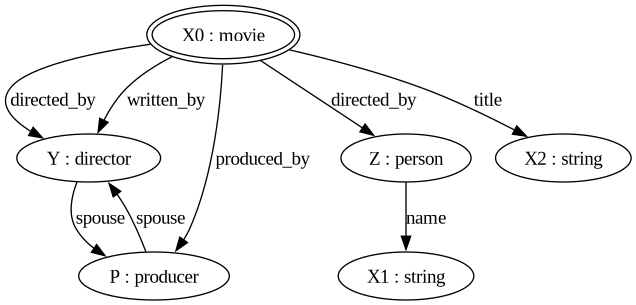
normalized_term = normalize_term(term, fuzzy_tax)
normalized_term.pretty_print()
X0 : movie(
    directed_by -> Y : director(
        name -> X1 : string
        spouse -> P : producer(
            spouse -> Y
        )
    )
    written_by -> Y
    produced_by -> P
    title -> X2 : string
)
display(normalized_term)
Fuzzy OSF term unification
Similarly to first-order terms, OSF terms can be unified. In fuzzy OSF logic, unification takes into account the sorts associated with the tags, and their fuzzy subsumption.
from fosf.syntax import NormalTerm
from fosf.reasoning import unify_terms
term1 = parse_term("X:thriller(directed_by -> Y:top, written_by -> Y)",
                   # If we know we are parsing a term which is in normal form, we can pass this argument
                   create_using=NormalTerm)
term1.pretty_print()
X : thriller(
    directed_by -> Y : top
    written_by -> Y
)
term2 = parse_term("Z:horror(directed_by -> director, written_by -> person)",
                   create_using=NormalTerm)
term2.pretty_print()
Z : horror(
    directed_by -> X0 : director
    written_by -> X1 : person
)
unifier, degree = unify_terms([term1, term2], fuzzy_tax, return_degree=True)
unifier.pretty_print()
print(degree)
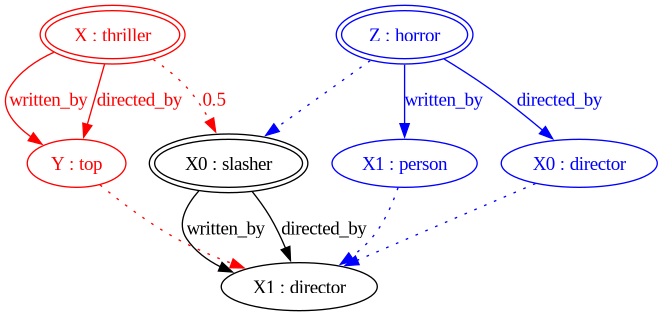
X0 : slasher(
    directed_by -> X1 : director
    written_by -> X1
)

0.5
In fuzzy OSF logic, we can compute a unification degree as the minimum subsumption degree between the unifier and each initial term. In this case, the unification degree is 0.5.
Visualization of how the terms are unified:
from fosf.utils.draw import unification_to_agraph
display(unification_to_agraph([term1, term2], fuzzy_tax))
Sort definitions
Sort definitions allow to specify structural constraints on OSF terms. E.g.: If X is a movie and X is directed by Y, then Y must be a director.
An OSF theory is composed of a (fuzzy) sort taxonomy and a set of sort definitions. An OSF theory should satisfy order-consistency, that is:
if s is a subsort of t, then s must inherit all of t’s constraints.
from fosf.parsers import parse_theory
theory_str = """
# fuzzy sort taxonomy
bot < director, writer, producer, string, slasher.
director, writer, producer < person.
slasher < horror, thriller (0.5).
thriller, horror < movie.
person, string, movie < top.

# sort definitions
person   := Yp:person(spouse -> Y1:person(spouse -> Yp)).     # The spouse of a person Yp must be a person, and their spouse must be Yp
director := Yd:director(spouse -> Y2:person(spouse -> Yd)).   # director is a subsort of person, so it must inherit the spouse constraint
writer   := Yw:writer(spouse -> Y3:person(spouse -> Yw)).     # same
producer := Ypr:producer(spouse -> Y4:person(spouse -> Ypr)). # same

movie    := Ym:movie(directed_by -> Y5: director).
thriller := Yt:thriller(directed_by -> Y6: director).
horror   := Yh:horror(directed_by -> Y7: director).
slasher  := Ys:slasher(directed_by -> Y8: director).

string := Ystr:string.
"""
theory = parse_theory(theory_str)
sort = "horror"
definition = theory[sort]
print(f"\nThe sort '{sort}' is defined as:")
definition.pretty_print()
The sort 'horror' is defined as:
Yh : horror(
    directed_by -> Y7 : director
)
Not every sort needs to be explicitly defined as above. Instead, one can specify only the essential ones and then close the theory.
theory_str = """
# sort taxonomy
bot < director, writer, producer, string, slasher.
director, writer, producer < person.
slasher < horror, thriller (0.5).
thriller, horror < movie.
person, string, movie < top.

# sort definitions
person := Yp:person(spouse -> Y1:person(spouse -> Yp)).
movie  := Ym:movie(directed_by -> Y5: director).
string := Ystr:string.
"""
theory = parse_theory(theory_str, ensure_closed=True)
Now, e.g., horror will inherit the constraints from movie.
definition = theory[sort]
print(f"\nThe sort '{sort}' is defined as:")
definition.pretty_print()
The sort 'horror' is defined as:
Yhorror : horror(
    directed_by -> Y5 : director
)
When a term is normalized, it can be normalized according to the given theory.
term = parse_term("X:movie(directed_by -> top)")
normal_term = normalize_term(term, theory.taxonomy, theory)
normal_term.pretty_print()
X : movie(
    directed_by -> X0 : director
)
Without passing the theory, the term would be normalized as usual (in this case the term is already in normal form)
normal_term_no_theory = normalize_term(term, theory.taxonomy)
normal_term_no_theory.pretty_print()
X : movie(
    directed_by -> X0 : top
)
The constraints in the theory are checked lazily. E.g.: if the feature directed_by is not specified, then there is no need to check that its value is of the correct sort.
term = parse_term("X:movie")
normal_term = normalize_term(term, theory.taxonomy, theory)
normal_term.pretty_print()
X : movie
Another example:
term = parse_term(
    """
    movie(
        directed_by -> top(spouse -> W:top),
        written_by -> W(spouse -> director)
    )
    """
)
normal_term = normalize_term(term, theory.taxonomy, theory)
normal_term.pretty_print()
X0 : movie(
    directed_by -> X1 : director(
        spouse -> W : person(
            spouse -> X1
        )
    )
    written_by -> W
)
Degree of satisfaction of a term with respect to a theory
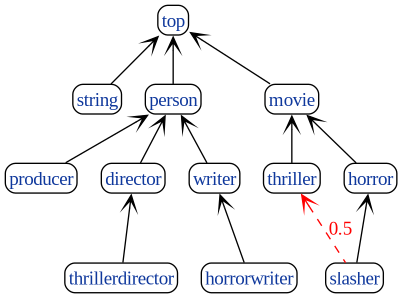
In fuzzy OSF logic, a term might satisfy the constraints imposed by the theory up to some degree in (0, 1].
theory_str = """
# sort taxonomy
bot < thrillerdirector, horrorwriter, producer, string, slasher.
director, writer, producer < person.
thrillerdirector < director.
horrorwriter < writer.
slasher < thriller (0.5), horror.
thriller, horror < movie.
person, string, movie < top.

# sort definitions
person := Yp:person(spouse -> Y1:person(
                                    spouse -> Yp,
                                    last_name -> Yn:string),
                    last_name -> Yn).
thrillerdirector := Yt:thrillerdirector(director_of -> Y2: thriller).
horrorwriter := Yh:horrorwriter(writer_of -> Y3: horror).
movie  := Ym:movie(directed_by -> Y5: director(director_of -> Ym),
                   written_by -> Y6: writer(writer_of -> Ym)).
"""
theory = parse_theory(theory_str, ensure_closed=True)
display(theory.taxonomy, drop="bot")
term_str = """
X:movie( directed_by -> X0:thrillerdirector(spouse -> X1),
       written_by -> X1:horrorwriter(spouse -> X0) )
"""
term = parse_term(term_str)
display(term)
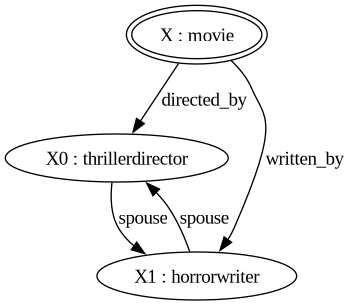
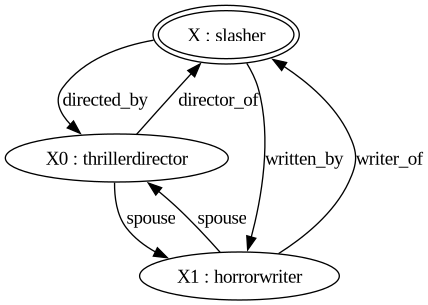
If we normalize the term according to the theory, it turns out that it should be a slasher:
normal_term, alpha = normalize_term(term, theory.taxonomy, theory, return_degree=True)
normal_term.pretty_print()
alpha
X : slasher(
    directed_by -> X0 : thrillerdirector(
        spouse -> X1 : horrorwriter(
            spouse -> X0
            writer_of -> X
        )
        director_of -> X
    )
    written_by -> X1
)
0.5
The term satisfies the theory with degree 0.5 since, according to the theory, a thrillerdirector directs thrillers.
display(normal_term)